


Surat's Rag-picker Women — Dignity, Struggle & Solidarity
Long before the city wakes up, they are already at work.
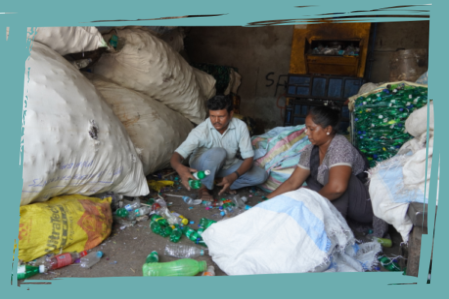
At around six in the morning, while most of Surat's residents are still asleep, a group of women move through its lanes collecting what others have thrown away. Plastic, paper, metal, glass discarded, forgotten, unwanted. These women gather it, carry it, sort it, and sell it. In doing so, they quietly perform one of the most essential services a city can have. And for most of their working lives, nobody has thanked them for it.
They are ragpickers. And their story is one of resilience, exploitation, collective action and eventually, dignity.
How It Began — Ten Women and a Vision
In 1997, ten women from Rasulabad came together with a simple but radical idea: that they did not have to be cheated anymore.
For years, ragpickers in Surat had been at the mercy of private waste traders. They were underpaid. Their waste was underweighed. They were kept in cycles of debt through advances that kept them bound to the same exploitative buyers, unable to sell elsewhere. It was a system designed to keep them small and dependent.
When the women of the Mahila Mandal had finally had enough, they approached Navsarjan for help. Navsarjan's response was to help them build something of their own a collective, a shop, a fair system. What began as Kagad Vinatí Baheno Nu Sangthan under the banner of Nari Pragati Mahila Mandal started from a modest hut. But it was their hut. And that changed everything.
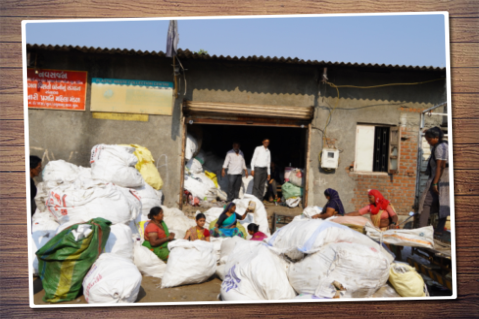
Word spread. Ten women became 120. Navsarjan supported the construction of a proper shop giving the collective a permanent home from which to operate.
How They Work : A Day in the Life
The rhythm of a ragpicker's day is both demanding and disciplined.
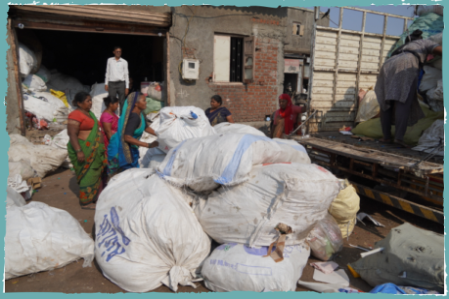
By 6 AM, the women are out, moving through the streets before the heat sets in, collecting waste from across their areas. The gathered materials are brought to designated collection points. From there, Navsarjan's truck picks up the waste and transports it to the central shop a change that transformed these women's lives in ways that are easy to underestimate.
Before the truck, these women carried everything on their heads. Every day. The weight of the city's waste, quite literally, on their bodies. The truck did not just reduce physical strain, it gave them back their afternoons. They could return home earlier, cook for their families, rest, and still fulfil their sorting duties. Time, it turned out, was a form of dignity too.
At the shop, the waste is sorted, weighed, and priced carefully and fairly with digital weighing machines that left no room for the cheating they had endured for years. Each woman receives payment based on her contribution. At year's end, any profit from sales is distributed among the members and shop employeesm a small but meaningful act of collective ownership.
Formalisation: Becoming Official (2018)
For over two decades, the association ran on solidarity and trust alone, without formal legal recognition. By 2018, this had become a practical barrier banks required a PAN Card, business transactions demanded a GST number, and operating informally was increasingly limiting their reach.
The women deliberated carefully. They did not want to become a charity. They did not want to become a corporation. They wanted something that preserved their character as a collective while giving them legal standing. They chose to constitute themselves as an Association of Persons (AOP) and in doing so, renamed themselves the Rag Picker's Association.
The Association was registered under the Gumasta Dhara (Shop and Establishment Act) with the Surat Municipal Corporation a quiet but significant milestone. These women, once invisible to every system that surrounded them, were now on the record.
The Struggle That Continues
Progress has not come without setbacks.
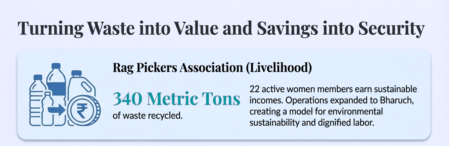
The introduction of door-to-door waste collection by the municipal corporation in many ways a good thing for the city had an unintended consequence for ragpickers. As open waste bins were removed, the women's primary source of waste disappeared with them. Membership, which had grown to 120 at its peak, fell sharply.
The work itself remains invisible to most people. The women who keep Surat's streets clean are not celebrated. They are not counted in most official statistics. And the formal recognition that their labour deserves in policy, in welfare schemes, in public consciousness remains frustratingly incomplete.
Navsarjan continues to fight on their behalf. It has advocated for their inclusion in formal waste management systems, helped them access government entitlements and welfare schemes, connected them to savings and credit programmes.
What This Story Is Really About
The Rag Picker's Association is, at its heart, a story about what happens when marginalised women decide they will no longer accept what is being handed to them.
It is about ten women who said enough, and built something together. It is about a community that formalised itself not because anyone told it to, but because it decided it was ready. It is about daily labour that holds a city together, performed by women whose names few people know.
Navsarjan's role in this story is not that of a rescuer. It is that of a companion walking alongside these women, providing tools, opening doors, and amplifying a voice that was always there, waiting to be heard.
The ragpickers of Surat are not a footnote in the city's development. They are part of its foundation. And they deserve to be treated that way.