

Bridge to School: Slum Education Initiative
There is a particular kind of quiet courage in a slum child who shows up to learn. No proper study space at home, parents gone before dawn, a home that speaks one language while the school speaks another. And yet, they come. Navsarjan's educational programmes exist to make sure that when they do, someone is ready for them.
Balwadis : Where Learning Begins
Before a child can dream of a classroom, they need to feel safe. For children in Surat's slum communities, many of whom are left alone while both parents head out for daily wage work, a Balwadi is exactly that a safe, warm place where learning begins and childhood is protected.
Run by Mahila Mandals under the NAVCHETNA Trust, these kindergartens are set up right inside the slum, taught by a teacher identified from the same community or nearby. There is no bus ride to a distant school. No unfamiliar faces. Just a neighbourhood space where small children take their first steps into education, in a language they actually understand.
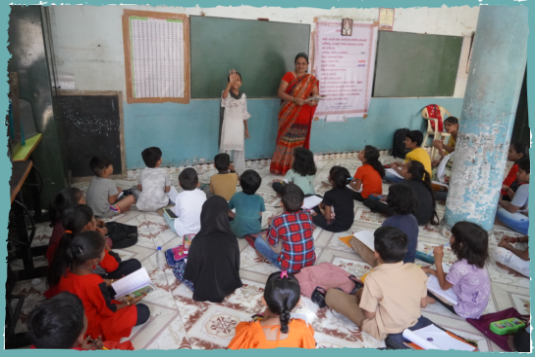
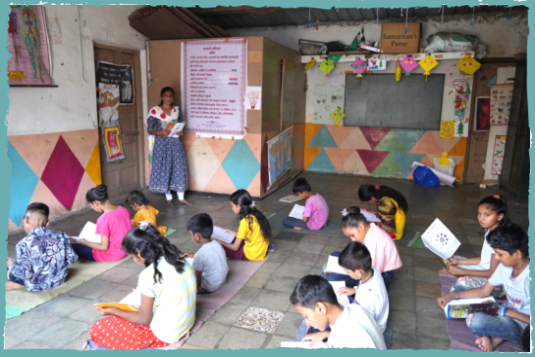
And that last part matters more than it may seem. The children in these slums come from migrant families who have travelled from across India. they speak Gujarati, Marathi, Hindi, and some Urdu. Most government systems are not built for this kind of diversity. The Balwadis are. Finding teachers who can teach in four different languages is a constant challenge, but Navsarjan meets it because no child should feel like a stranger in their own classroom.
For children whose parents are often illiterate and engaged in unorganised labour, the Balwadi does something else that is quietly profound, it gives these children a head-start before they enter the Municipal Corporation's primary school. In a school system where slum children often slip through the cracks, arriving with some early education behind them makes all the difference. They are not starting from behind. They are starting ready.
Tuition Classes: Staying in the Race
Getting a child into school is one battle. Keeping them there and helping them actually learn is another.
Most slum homes are a single room. One room for sleeping, cooking, living, and somehow, studying. There is no quiet corner. No desk. No space to spread out a notebook without someone sitting on it. For a child trying to do homework after a long school day, the odds are stacked against them before they even open their book.
Navsarjan's tuition classes change that equation. Every day, for about two hours, students gather in a nearby space with a teacher who is there not just to help them finish homework, but to support, monitor, and encourage their learning. The tuition classes are organized into two-hour batches, with students from different standards attending in separate groups. During these sessions, teachers focus on core subjects like Maths, English, and Science, giving each group the attention suited to their level. It is structure when home cannot offer it. It is attention when a crowded classroom could not spare it.
Running these classes is not without its own challenges, finding teachers who are both competent and committed, working with parents to help them understand the value of consistent attendance, and keeping children motivated when life around them offers so many reasons to give up. These are real, daily struggles that Navsarjan's field teams navigate with patience and persistence.
Navsarjan's Role : Keeping the Quality Alive
A classroom is only as good as what happens inside it. Navsarjan takes responsibility for making sure the quality of teaching is never left to chance.
Teachers are carefully selected and trained before the academic year begins with ten days of in-service training at the start of the year and another ten days during mid-term holidays to refresh and upgrade their skills. This is not a one-time investment. It is an ongoing commitment to the people who stand in front of these children every day.
Students are assessed through monthly tests and bi-annual mid-term evaluations, giving teachers and coordinators a clear picture of who is learning, who is struggling, and what needs to change. This culture of regular assessment and honest review has lifted both the performance of students and the confidence of teachers creating a learning environment where growth is not left to chance.
What Education Really Means Here
For a child growing up in a slum, education is not just about grades. It is about possibility. It is the thing that changes what is imaginable for a family within a generation.
Navsarjan's Balwadis and tuition classes are not grand interventions. They are quiet, daily acts of investment in children who deserve to be seen, taught, and believed in and in communities that deserve to know their children are in good hands.